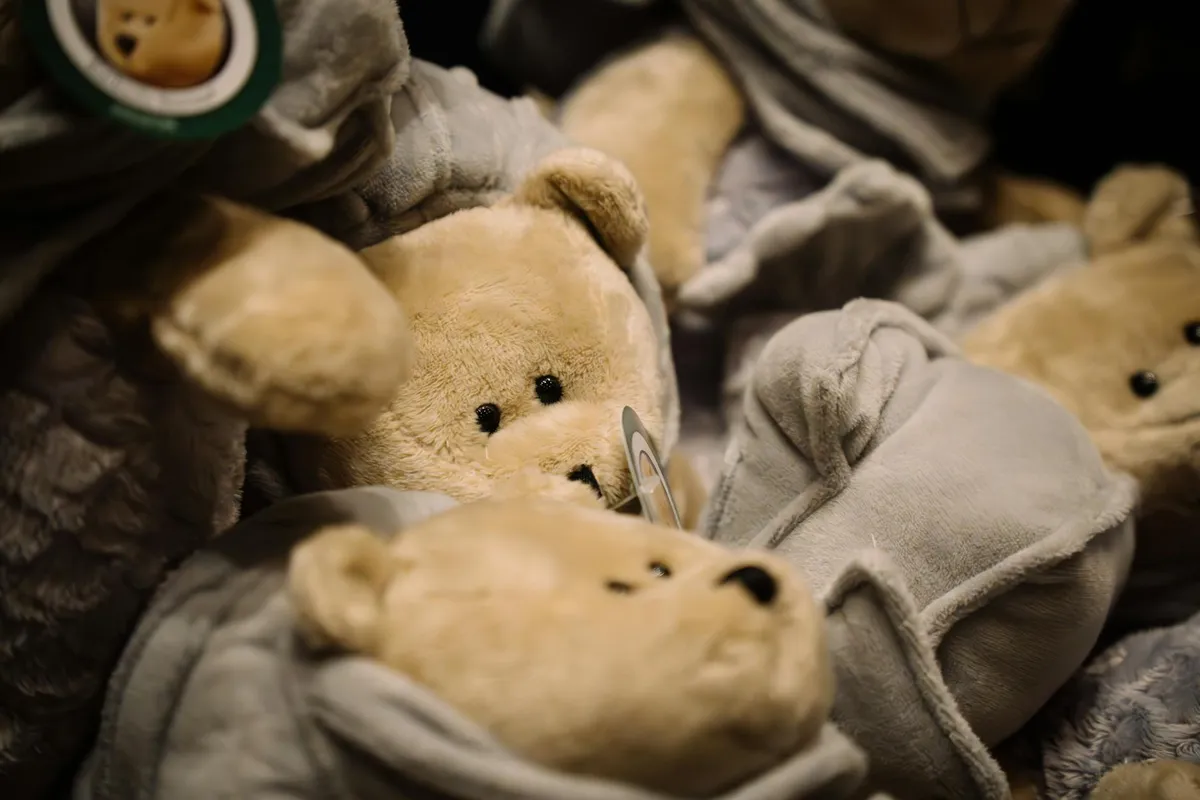
I've sold somewhere between 8,000 and 10,000 teddy bears across the eleven years of running Teddies of Mt Holly. (Yes, the shop is named after them. Yes, that's on purpose. Yes, my landlord thinks it's ridiculous.) I've watched specific bears fly off the shelves and others sit there looking sad for two years before going on the clearance table.
Patterns emerged. The bears that actually make people happy share specific traits. The bears that disappoint share different specific traits. Most teddy bear advice online is either marketing copy from manufacturers or generic "look for quality stitching" lists that don't actually help you pick.
Here's what I've learned actually matters.
The face is most of the bear
This is the single biggest thing I wish I'd understood earlier in the shop's life.
The face determines whether someone wants the bear. Body proportions, fur quality, fill density — all of these matter. None of them matter as much as the face.
What makes a good face:
Eyes that look at you, not past you. The eye placement and angle matters enormously. Bears with eyes set too wide look vacant. Eyes set too close look anxious. The sweet spot is specific and most cheap bears miss it.
A muzzle that suggests warmth without being cartoonish. Muzzle stitching, position, and contour combine to create either a friendly or a flat face. The good bears have specific muzzle shapes that read as warm.
Ears that match the head proportions. Tiny ears on a big head looks weird. Huge ears on a tiny head looks weirder. The bears people actually pick up have proportional ears.
An expression that's settled rather than blank. The best bears have faces that look like they're thinking something. Not actively expressing something — settled, like a person who's comfortable in their own skin.
I can usually tell within ten seconds of unpacking a new bear whether it's going to sell. The face does most of the work.
Weight matters more than people think
Pick up a cheap mass-market teddy bear. Then pick up a good one. The weight difference is dramatic.
Cheap bears are stuffed lightly with synthetic fill that compresses. They feel hollow when you hug them.
Good bears have substantial weight — sometimes pellets in the bottom for stability, denser fill throughout, sometimes specific weighted regions in the paws.
The weight matters because:
It tells your hands the bear is "real." There's some specific tactile feedback that registers as quality even before you consciously process it.
It makes the bear sit properly. Light bears flop over. Heavy bears sit up like they're paying attention.
It makes the bear feel substantial when held. Hugging a hollow bear is sad. Hugging a substantial bear is satisfying in a way that's hard to explain but immediately obvious.
Weight is one of the easiest things to evaluate in a shop and one of the things people consistently underweight when shopping online (where you literally can't feel it).
Fur isn't about being soft
People think bear quality is about how soft the fur is. Sort of. Mostly not.
The really cheap bears have super-soft synthetic fur that mats after one wash and looks tatty within months. The really good bears often have slightly less aggressively soft fur that holds up across years.
What matters about fur:
Density. Thick, full fur looks substantial. Sparse fur looks cheap immediately.
Even pile direction. Cheap bears have fur going every direction. Good bears have fur with consistent direction that looks like a real animal's coat.
Recovery. Push your finger into the fur. Does it spring back? Cheap bears stay matted. Good bears recover.
Edge finishing. Look at the edges where fur meets seams. Good bears have neat edges. Cheap bears have stray fibers and uneven cutting.
Color quality. Cheap bear "browns" are often weirdly tinted. Good bears have proper natural-looking colors that don't make you wonder if there's something off.
Softness is fine. Softness without these other qualities is a red flag.
Stitching tells you everything
Turn the bear over. Look at the back of the head where the fur seams meet. Look at the seam under the chin. Look where the limbs attach to the body.
Good stitching:
Tight, even stitches with no visible thread.
Seams that are basically invisible because they've been sewn from inside and the fur covers them naturally.
Limb attachments that are reinforced and don't show stress.
Eye and nose attachments that are securely embedded.
Bad stitching:
Visible thread, especially at color seams.
Loose stitches anywhere — these will give out within a year of normal use.
Limb attachments that pucker or look stressed when you move the limbs.
Eyes that wiggle. Eyes that wiggle today come off tomorrow. This is a major safety issue for bears intended for kids.
I check stitching on every bear before I put it on the shelf. The ones with bad stitching go back to the supplier or get marked down to clearance with full disclosure to anyone buying them.
Size has its own dynamics
Small bears (8-12 inches) are the gift impulse purchase. People buy them for "just because" gifts.
Medium bears (14-18 inches) are the most common purchase for kids. The size is right for hugging.
Large bears (20-30 inches) are the special occasion purchase. New baby gifts, big birthday gifts, sometimes anniversary gifts.
Giant bears (over 30 inches) are mostly bought as "wow factor" gifts. They're almost never the bear that ends up being the favorite. The size makes them less practical for actual hugging.
Each size has its own quality dynamics. Small bears need precise face work because flaws are obvious. Large bears need substantial fill density because hollow looks worse at scale. Giant bears need exceptional structure or they sag into shapes that are sad.
The same supplier often makes different quality across sizes. I evaluate each size separately.
The price-quality relationship is messy
Higher price doesn't reliably mean higher quality.
I've sold $25 bears that beat $80 bears for face quality, fur quality, and stitching. I've sold $80 bears that earned every dollar.
What price actually correlates with:
Brand name (often the markup is mostly brand).
Materials cost (some specific materials genuinely cost more).
Where it's made (small-batch European or American makers cost more for genuine quality reasons).
Limited edition or collectible status (the markup may have nothing to do with construction).
What price doesn't reliably correlate with:
Face quality.
Long-term durability.
Whether someone will actually love the bear.
Some of my best-loved bears in customer feedback are mid-priced ones I almost didn't carry because the supplier was small and I didn't recognize them.
What separates loved bears from given-and-forgotten bears
I get follow-up information on a lot of the bears we sell. Customers come back. They tell stories. They send me photos.
The bears that become loved long-term:
Have faces with specific personality. They look like someone, not just like a bear.
Are sized right for the person they go to. Too small and they get lost. Too large and they're awkward.
Are durable enough to survive being loved hard. The cheap bears that fall apart in two years don't become long-term beloved.
Have something specifically distinctive. A particular color combination. An unusual pose. A specific feature that makes them not just "a teddy bear" but "this teddy bear."
The bears that get given and forgotten:
Look generic from across the room.
Are sized for the gift moment, not for who actually receives them.
Don't survive their first wash or first year of love.
Look like other bears the recipient already has.
The difference matters. A teddy bear that becomes loved long-term is different from one that's a generic gift.
What I'd tell you if you were buying for a kid
Buy slightly bigger than you think.
Pick a face that looks specifically friendly to you. If you respond to it, the kid will too.
Check the eyes are firmly attached for under-3 safety.
Pick natural colors — the synthetic-bright bears photograph well but get tired-looking faster.
Don't pay for brand. Pay for face quality, weight, and stitching.
If you can't see and feel the bear before buying, buy from a place that takes returns.
What I'd tell you if you were buying for an adult
The face matters even more for adults than for kids. Adult bears get displayed; their faces will be looked at every day.
Smaller bears often work better for adults than the kid-instinct toward big bears.
Quality matters more relative to price. Adults notice cheap construction.
Specific personality matters most. Generic bears don't connect with adult recipients the way distinctive bears do.
The right bear for an adult is a specific bear. There's rarely a "this works for everyone" answer.
What eleven years has taught me
Most teddy bears are mediocre. The mass-market machine produces enormous quantities of bears that are technically bears and that mostly fail to produce the response a teddy bear is supposed to produce.
The bears that actually do their job — make someone feel something specific when they see or hold the bear — are a smaller subset. They share the patterns I've described. They're findable but you have to know what you're looking for.
I curate the shop based on these patterns. Most bears I look at don't make the cut. The ones that do tend to develop returning customers.
If you're buying a teddy bear and you remember nothing else from this post: look at the face for ten full seconds and ask yourself if it has personality. If yes, check the weight and stitching to make sure it'll last. That's most of what you need.
The rest is just shopping.